A shop that was never really a shop.
CKLS design, install and maintain commercial kitchens and laundries for care homes, schools and hotels. Their website sold machines from a basket nobody filled, and a catalogue that minted endless filter URLs had scrapers crawling it around the clock. We rebuilt all 2,284 pages on Astro and carried 2,714 old URLs across without breaking one.
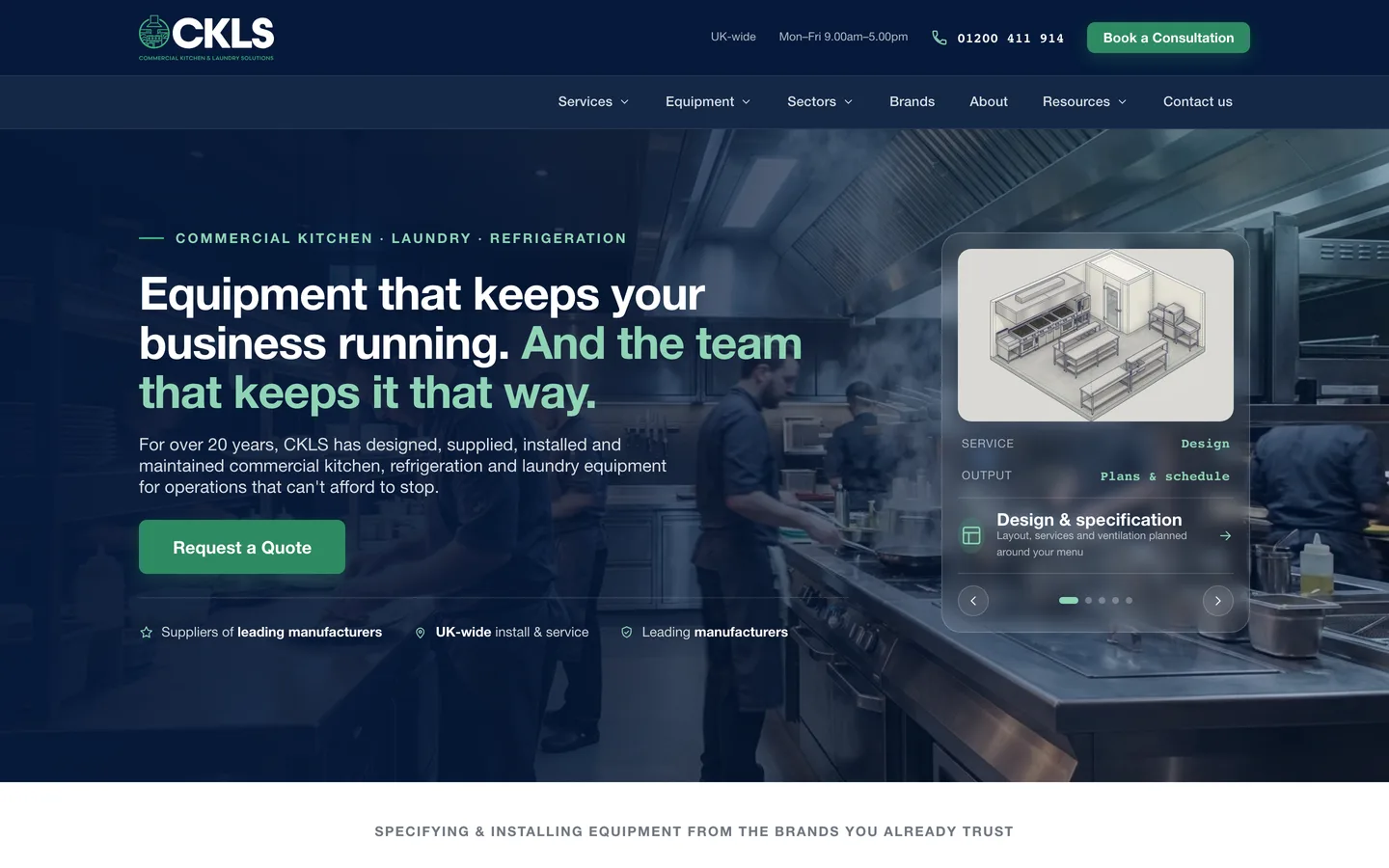
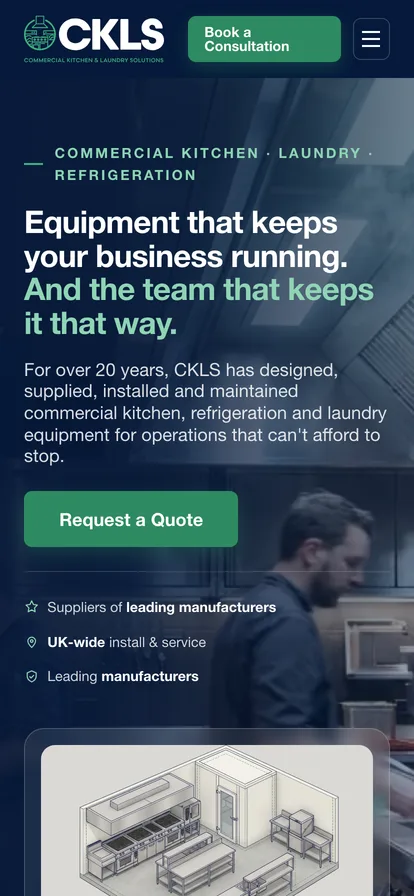
Drag to compare.
The homepage, side by side. WordPress on the left, Astro on the right. Pull the handle.
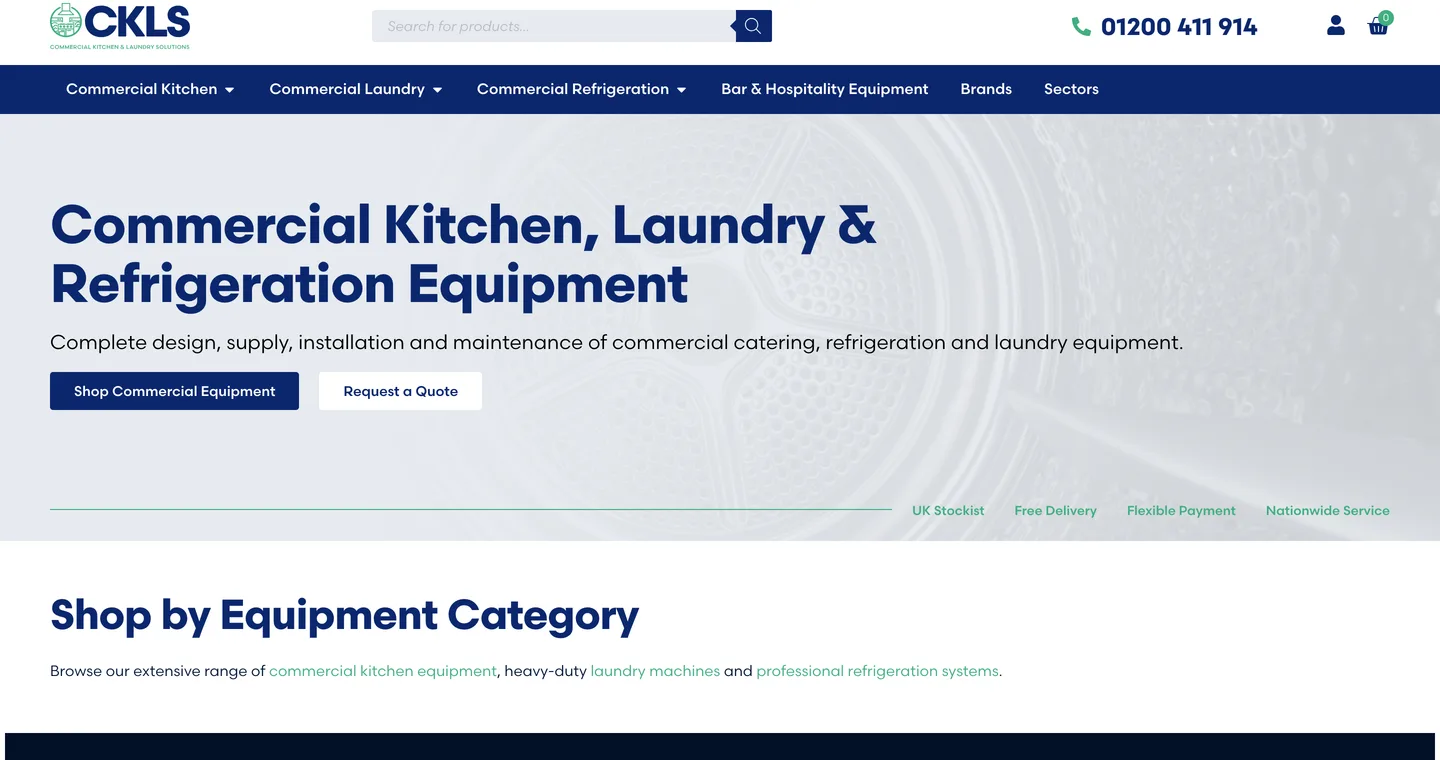
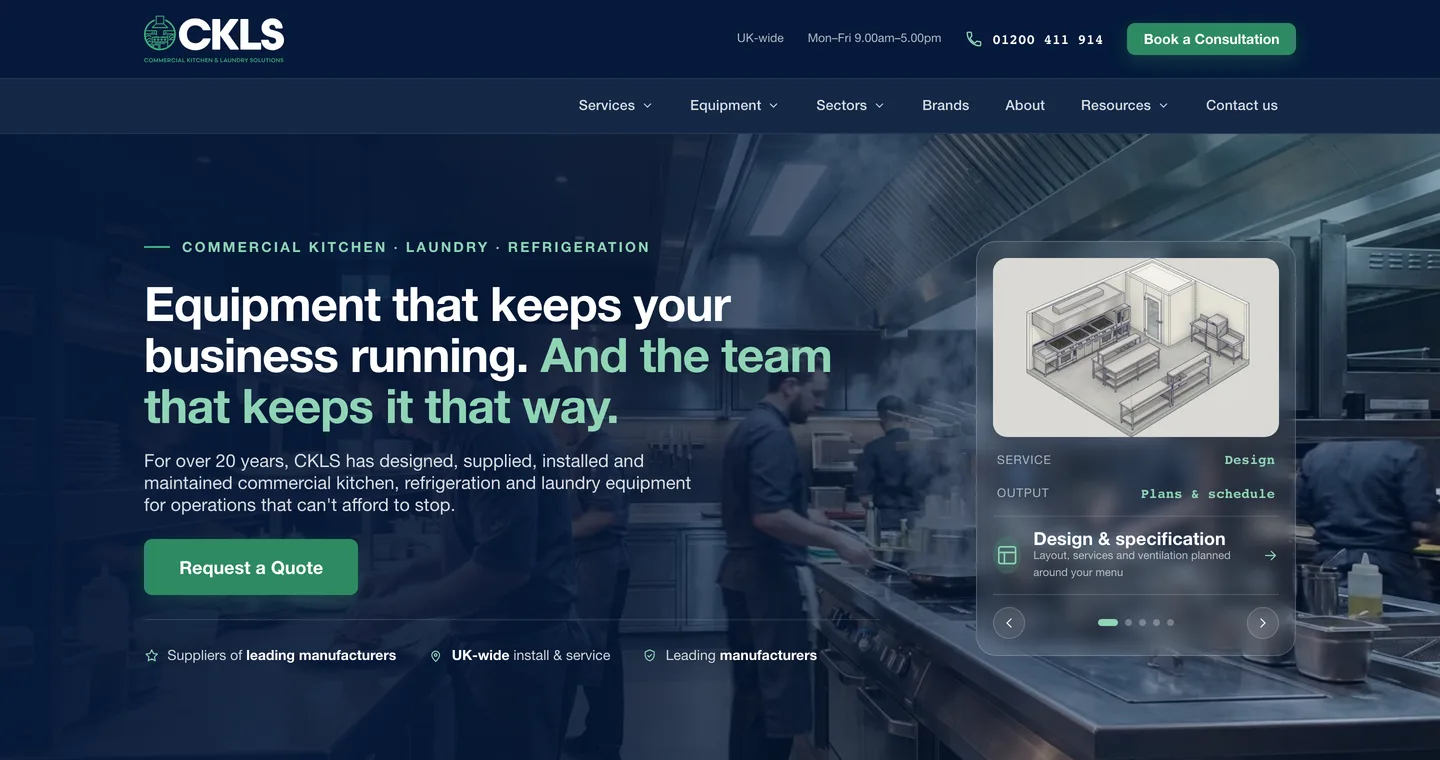 Before After
Not a bigger site. A better-shaped one.
CKLS: a service business wearing a shop’s clothes.
Chloe and the CKLS team have spent twenty years designing, supplying, installing and maintaining commercial kitchens, laundries and refrigeration out of Clitheroe, for care homes, schools, hotels, pubs and industrial sites across the UK. The design work and the servicing contracts are the business. The equipment is how it gets delivered.
The website said the opposite. A product search across the masthead, a basket sitting on nought, and Shop Commercial Equipment as the first thing anyone was asked to do, with the design, installation and maintenance work filed somewhere below it. Ten to fifteen enquiries a month arrived and the quality was a mixed bag, which is exactly what a shop-shaped page attracts: people pricing one machine, not people planning a kitchen.
A care home manager wants a partner, not a parcel.
The old homepage opened with Shop Commercial Equipment, a product search and a basket. CKLS design kitchens, fit them, commission them and come back when something stops at six on a Friday. All of that sat underneath the shop.
A page built like a shop filters for someone pricing one machine against three other tabs. It does not filter for the manager replacing a laundry over a weekend, or the bursar ripping a kitchen out in the summer holidays. Same traffic, entirely different enquiry.
So the new site leads with the work and keeps the catalogue as proof rather than pitch. All 2,104 products are still there. They stopped pretending to be the business.
Google had a key. Everyone else read the closed sign.
This was never a bad website. It was a tidy, modern WooCommerce shop that had quietly been left to carry a handful of problems it could not fix by itself. The biggest was a CDN allowlist that waved Google through and returned a 403 to nine pages in ten for everything else, which is why CKLS had never been cited once in an AI answer while the category leader had been mentioned 942 times.
What the audit found
- A CDN allowlist returning 403 to nine pages in ten for every crawler except Google’s. Part of the defences the site had accumulated, and nobody had gone back to check what it was turning away.
- An unfinished www migration: 683 of 733 backlinks pointing at the version Google had decided was the spare.
- 959 ranked keywords and 19 of them in the top ten. In the building, but not in the room.
- Category filters that wrote themselves into the URL, spawning near-empty crawlable pages by power supply, by amperage, by door count. A scraping botnet was still working through them months later.
- A homepage selling a shop. Product search, a basket and “Shop Commercial Equipment” above the design, installation and maintenance work that actually wins the jobs.
- Elementor, which stores every page as serialised JSON in the database. A reasonable call in 2018. A ceiling by 2026, and impossible to work on with agents.
What CKLS wanted
- Better enquiries, not just more of them. Projects rather than price checks on a single machine.
- To be findable by sector and by town, not only by the people who already knew the name.
- To keep the catalogue. Two thousand products and years of ranking history were not up for sacrificing to a replatform.
- A partner who would say when something was not worth paying for. They had done the agency-activity thing before.
The catalogue was printing its own URLs, and the bots found them.
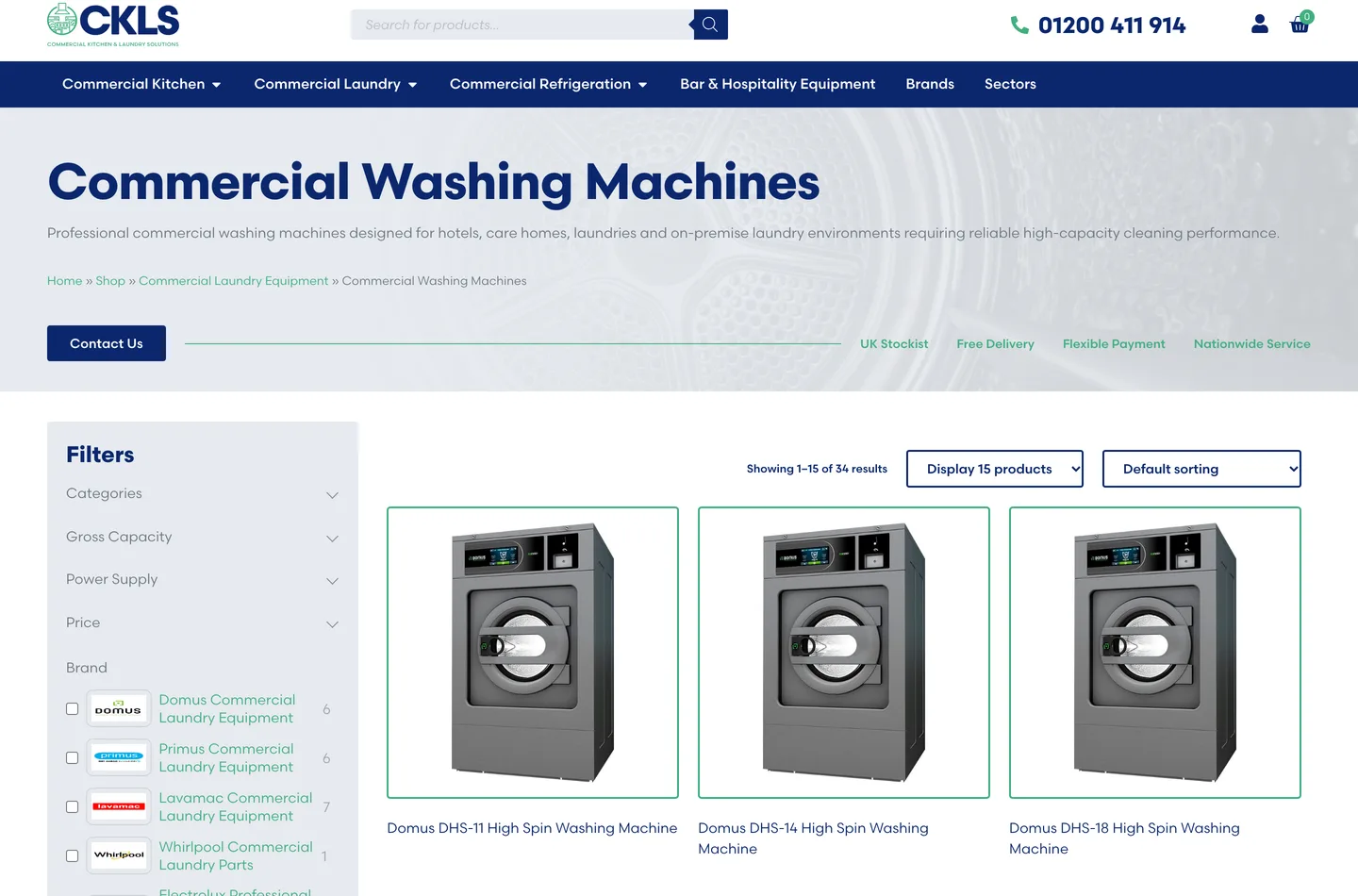
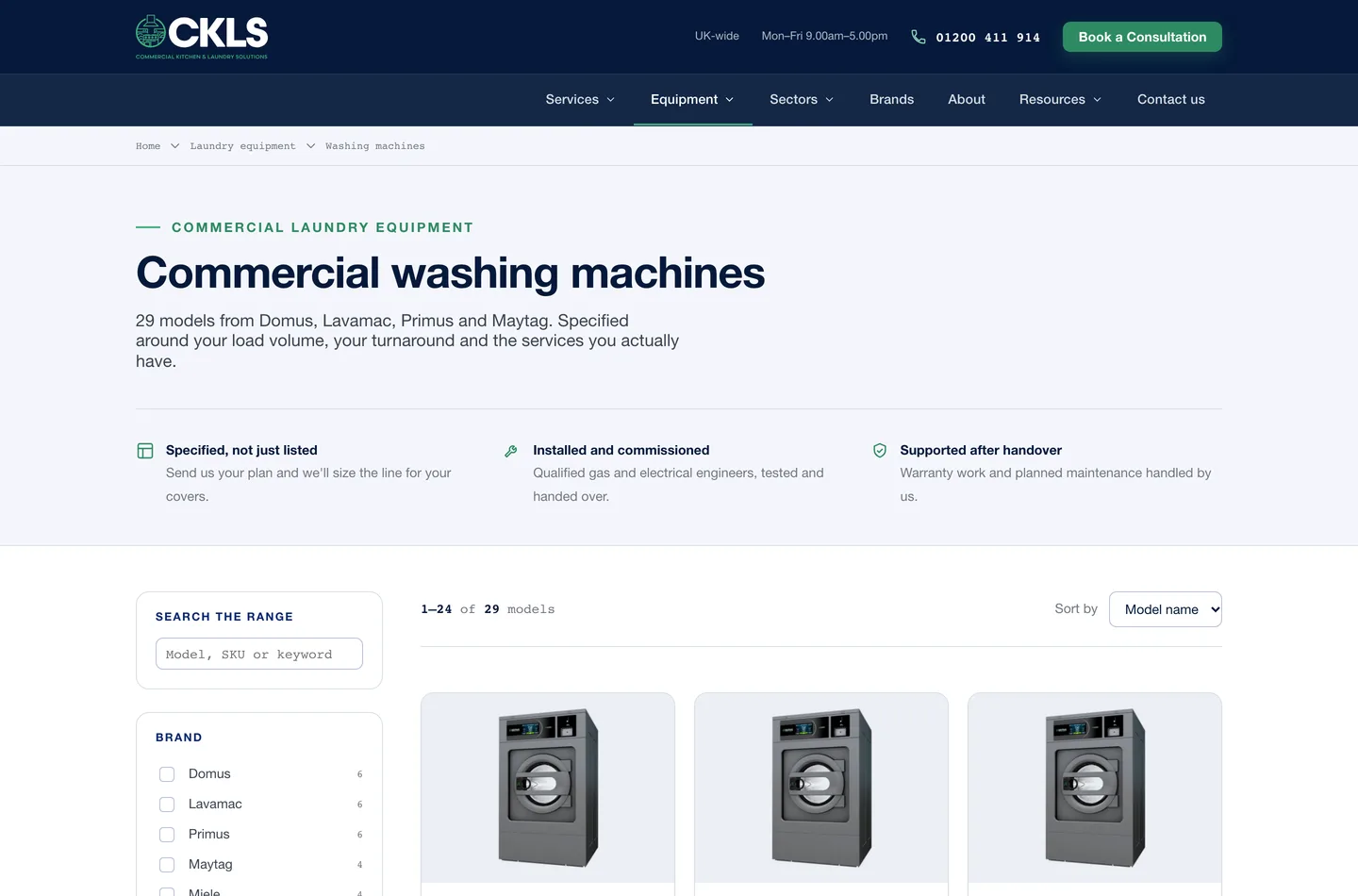
The old product library let its filters write to the address bar. Brand, capacity, power supply, door count, defrost type, every combination a crawlable page, which meant a site with no bottom to it. Scrapers settled in and worked through it around the clock. Holding the server up meant blocking traffic at the edge, and rules broad enough to stop the scrapers also turned away the engines CKLS needed to be read by. The defences keeping the site alive were the same ones keeping it invisible. You cannot write your way out of that, because the catalogue mints the problem faster than anyone can block it. So we rebuilt it, and the new filters never touch the URL at all.
Every page, redrawn.
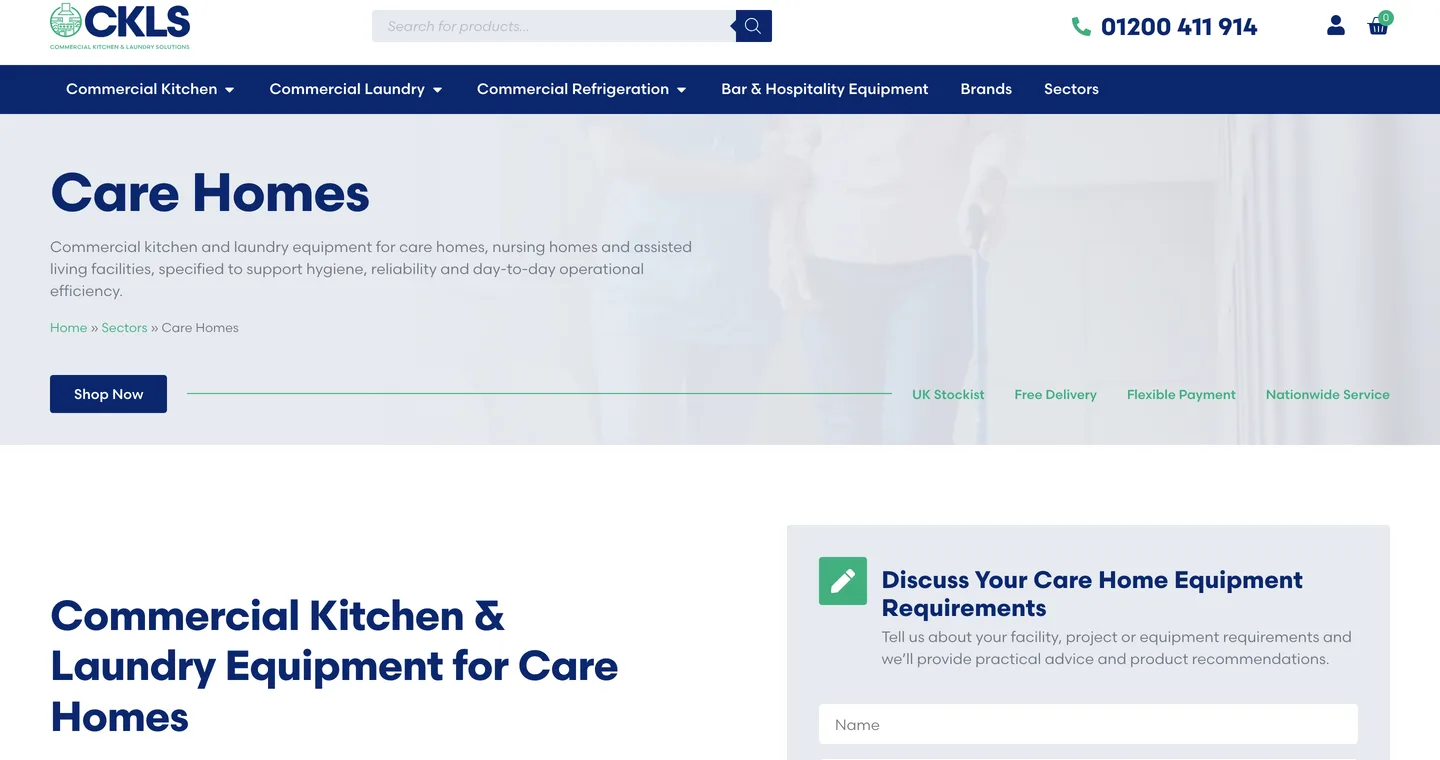
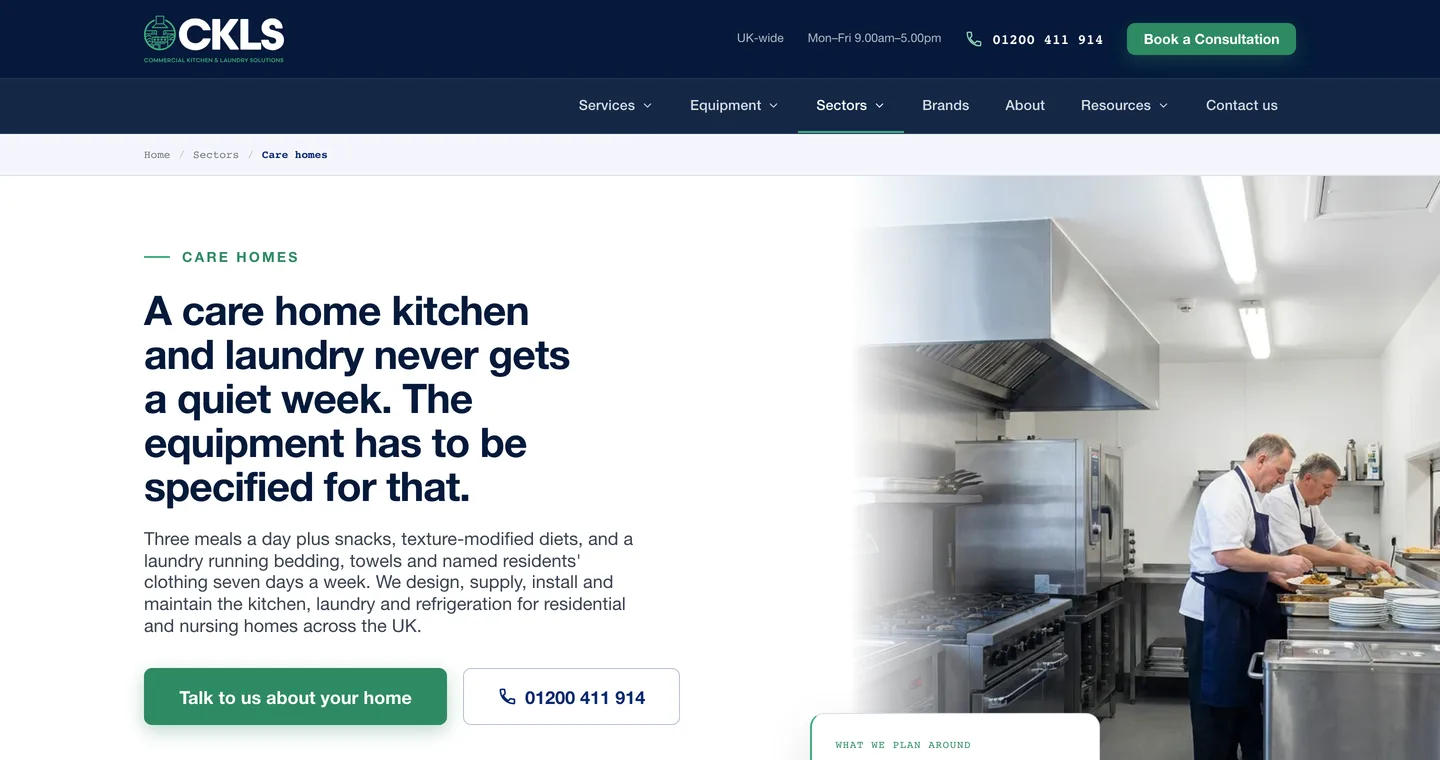
The homepage without the wipe, then the two pages that show the shift best: a care home page that used to say Shop Now, and a category that used to let its own filters loose on Google.
2,530 product URLs, and not one of them where we expected.
The redirect plan assumed the old products sat under a /product/ path. The day before DNS, a check against the real site said otherwise: they sat under their category, and 2,545 old URLs would have 404’d on launch. So we crawled every one of the old product pages for its SKU and matched on that instead of on the slug.
Three things we found on the day
- A firewall rule blocking an AI crawler’s entire IP range, added to protect the old server. It was keeping CKLS out of that assistant’s answers. Removed.
- A scraping botnet, 282 rotating IPs faking Chrome, hammering old WooCommerce filter URLs at about 10,000 an hour. Blocked at the edge by path, and invocations fell from 287 per 95 seconds to five.
- An old security rule that answered any URL containing
-or-with a 403, including one live product page. Narrowed, not deleted, because it was still earning its keep.
The old site stayed up for two weeks afterwards, and the rollback was one DNS record. We did not need it.
Two thousand two hundred and eighty-four pages that say what they are.
Nobody asks an assistant for commercial catering solutions. They ask who services a Rational oven in Blackburn, or what a care home laundry needs to pass an infection-control audit. Answering that takes a page about the brand, a page about the town, a page about the sector, and the markup that ties them to a real company at a real address.
Lighthouse 12.8, mobile, both homepages on 26 October 2026. The before is the old WordPress build, still served from its own origin on a preview hostname, so it is the same site on the same hosting rather than a reconstruction. Accessibility went 81 to 91 and SEO was already 100, so neither is doing any work in that row.
He has taken the time to really understand our business, what we do and what we want to achieve, and the advice he has given throughout the process has been invaluable. Nothing ever feels like too much trouble, and you can tell he genuinely cares about getting the best result for his clients rather than simply delivering a website.
This site is five days old. The traffic chart for the first week is useless: a scraping botnet put 271 sessions through it in a day, and the ranking snapshot taken across the cutover went down before it goes anywhere, which is what a URL change does for a few weeks. Anyone showing you a results graph at this stage is showing you noise.
One thing is worth reporting, because it is the door this whole job was about opening. Across 36 tracked buyer prompts, CKLS had never been cited by any answer engine. This month Perplexity cited them for “who services commercial kitchen equipment uk”. One citation out of thirty-six is not a victory. It is the first one in a category where almost nobody has started. We will put the real numbers on this page when there are some.