A 7,700 sq ft showroom, properly online.
Kitchens, bathrooms, bedrooms and tiles under one roof in Bamber Bridge, and a website that showed you almost none of it. Every range on the floor was a photograph in a gallery. We rebuilt the site as 546 pages on Astro, gave 316 of those ranges a page a customer can actually land on, and carried 1,045 old URLs across so nothing that ranked went dark. Our biggest build so far, by some distance.
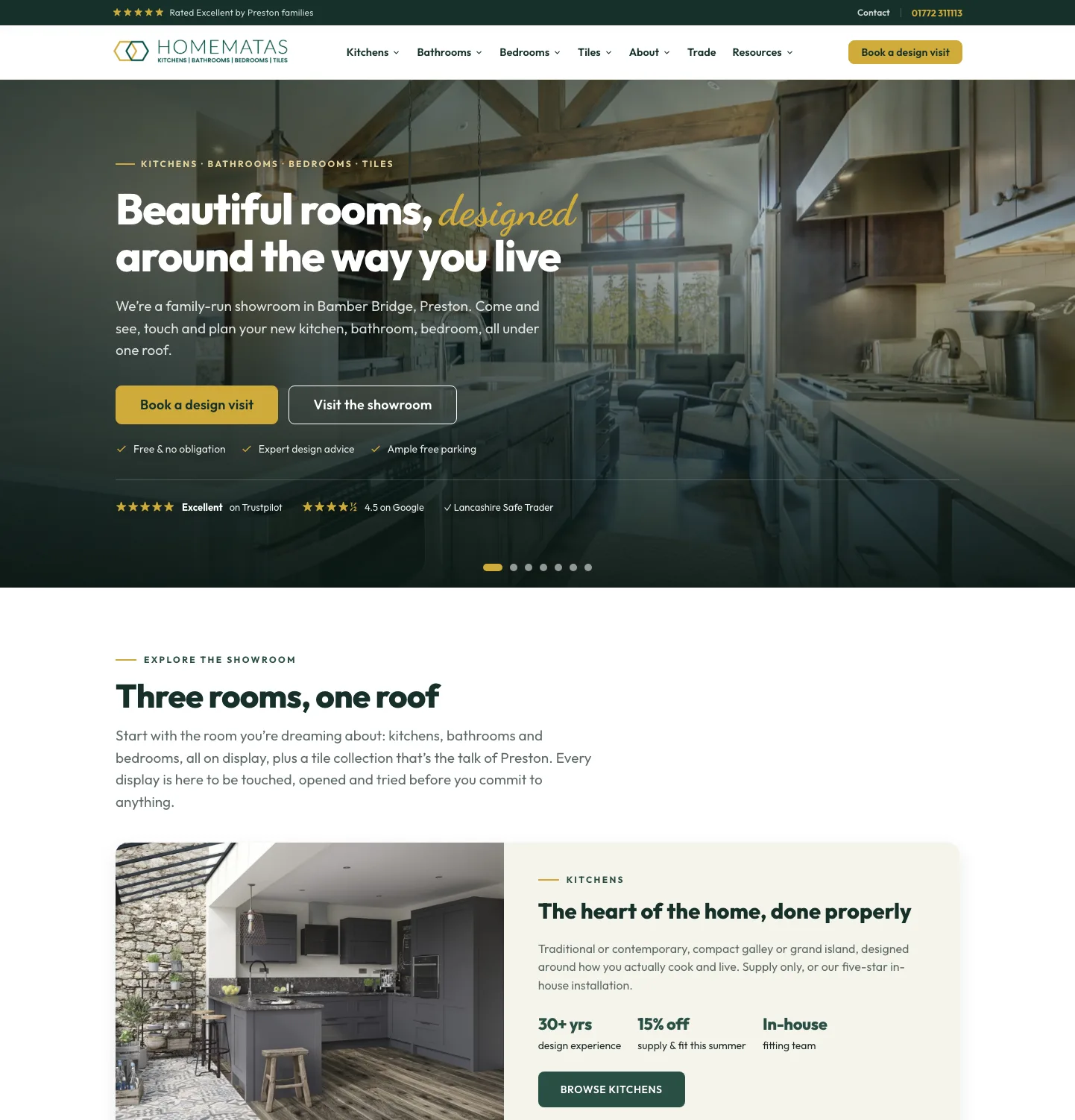
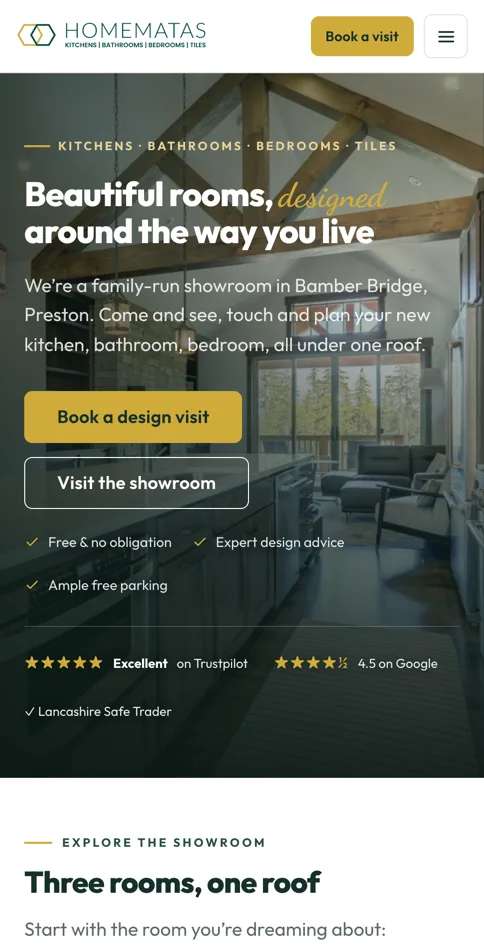
Drag to compare.
The homepage, same fold. Old on the left, new on the right. Pull the handle.
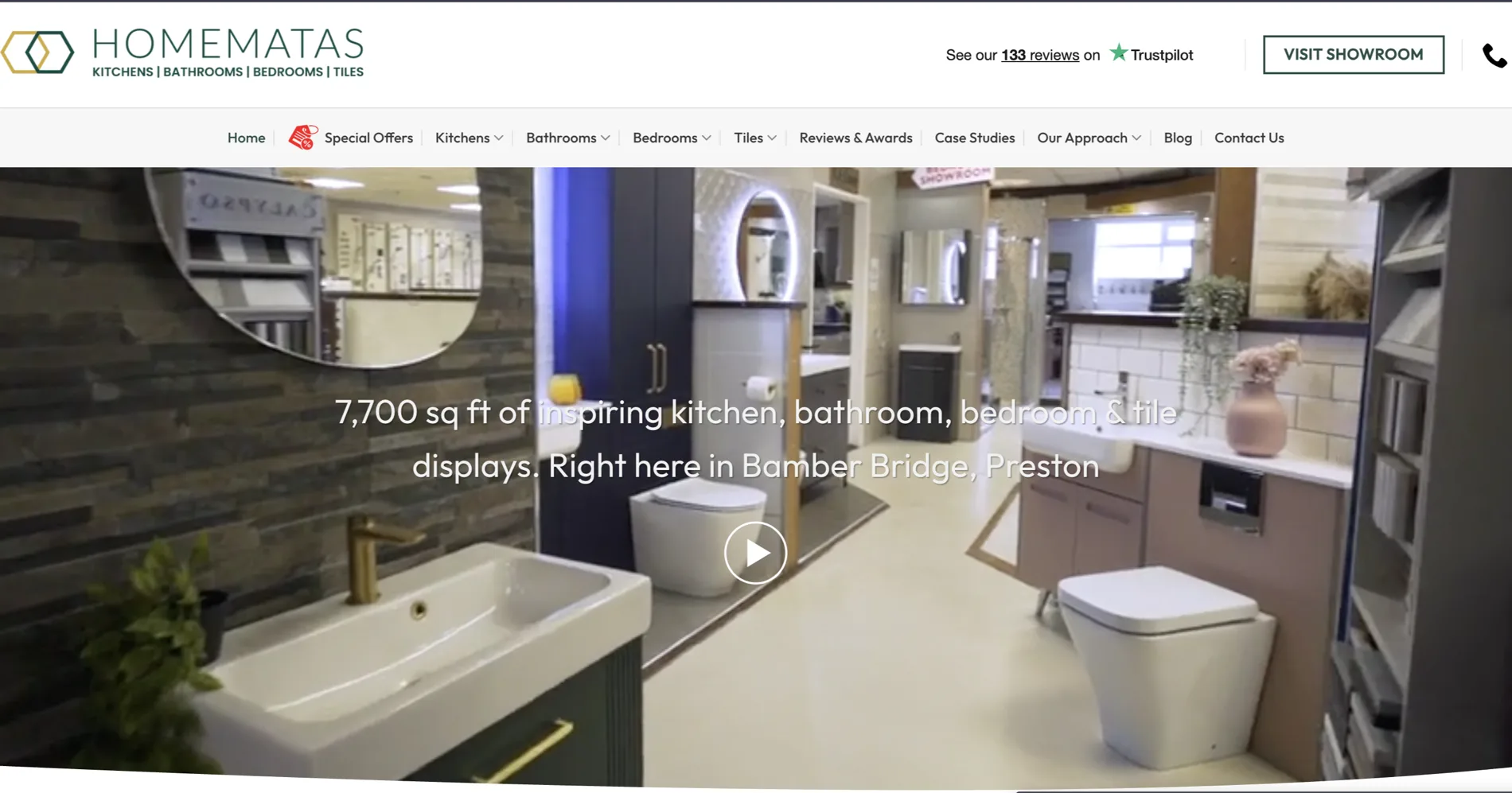
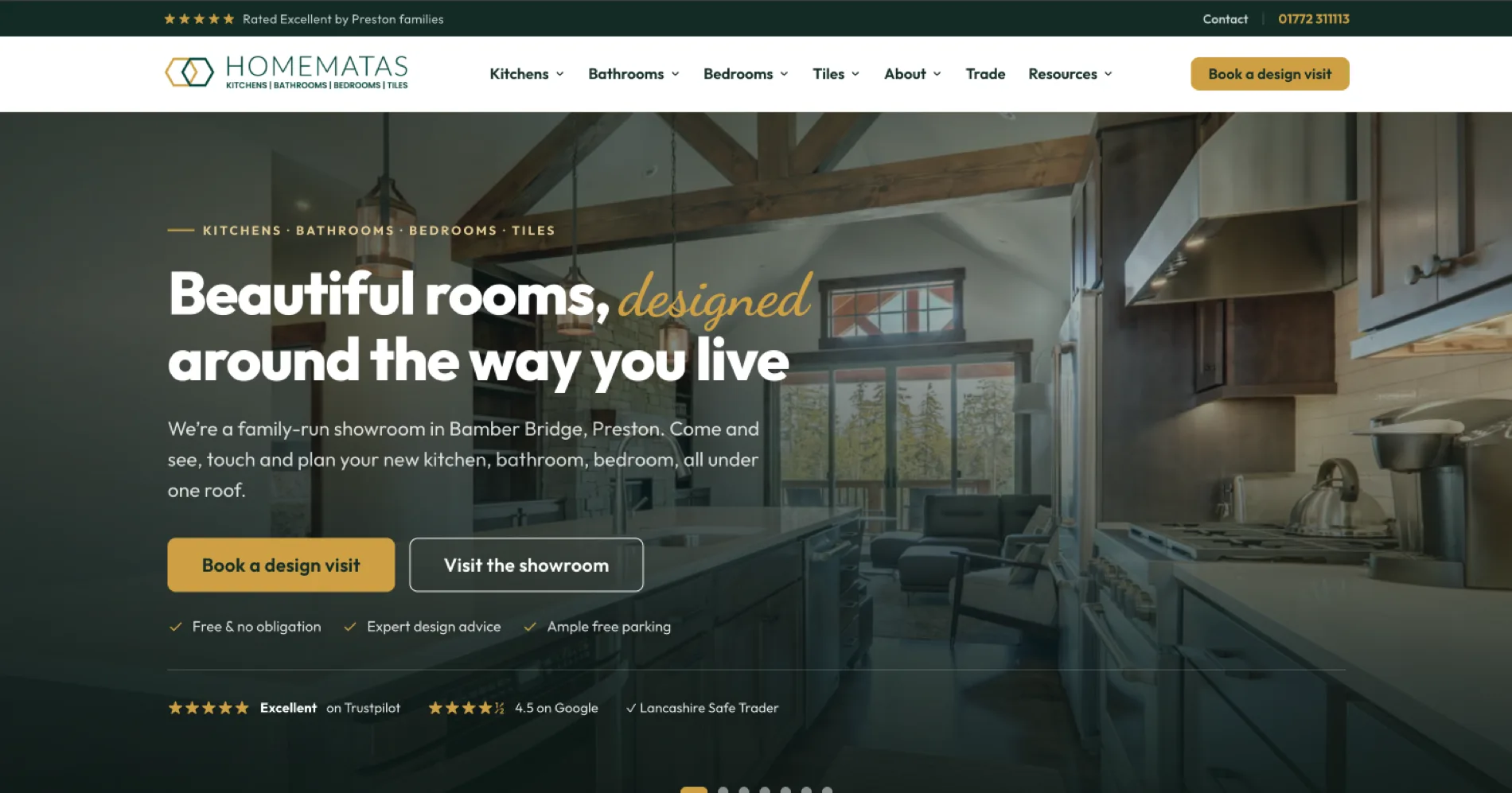 Before After
 Bigger, tidier, and readable by machines.
Everything under one roof, and a website that made you take it on trust.
Homematas is a family-run showroom on Dewhurst Row in Bamber Bridge, just outside Preston. Kitchens, bathrooms, bedrooms and tiles, all displayed in the same 7,700 sq ft building, designed and fitted by the same local team. That combination is the business. No other showroom within a few miles does all four.
The website said it in a sentence and then stopped. Ranges lived as photographs in a gallery, so somebody searching for a shaker kitchen in a particular colour had nothing to land on. The site had also been quietly losing ground: our audit put it at 420 estimated monthly visits in May 2026, down from 656 in January, with 386 pages carrying no meta description at all. The showroom was doing the work. The site was watching.
A showroom is an argument for coming in person. The site never made it.
People do not buy a kitchen off a web page. They buy it after standing in front of one, opening a drawer and arguing about the worktop. Everything on the new site is pointed at getting somebody through the door on Dewhurst Row: a free design visit as the single call to action, opening hours and parking where you can find them, and a page for every range so the search that starts at 11pm on a phone ends up in the diary.
Ten years of WordPress, and nowhere to put a kitchen.
The old site was not neglected so much as overgrown. A decade of plugins, a WooCommerce shop nobody needed, 200-odd blog posts and a media library that had quietly published itself as pages. Underneath all of it, the four things the business actually sells had one thin page each.
What the audit found
- 386 pages with no meta description, including every category and subcategory page on the site.
- 238 images with no alt text, on a site whose entire proposition is visual.
- Around 2,100 crawl warnings in total, including 487 broken outbound links to suppliers and 483 internal links pointing at old redirects.
- Identical boilerplate structured data on every page and not one Product or FAQ entry anywhere. The local market leader was taking roughly seven times the AI Overview citations on the back of exactly that.
- Media pages published as content, with slugs like
/kitchens-preston/attachment/7/and a colour swatch filed under a spelling of burgundy that has not been seen elsewhere.
What Homematas wanted
- More people through the showroom door, and more design visits in the diary. Bookings, not impressions.
- The ranges on the floor visible online, so a customer can arrive already knowing what they want to see.
- To stop the slide in visibility, then start closing the gap to the local leader rather than watching it widen.
- The trade side given a front door of its own. Builders and developers had been buying by phone with nothing to point them at.
- Ten years of blog posts kept, not thrown away. Some of them are the only pages an AI assistant currently cites.
Seven steps, two months.
Audit to launch, run end to end by us. The same Astro build we ran for TNT Scaffolding, pointed at roughly forty times the content.
Every page, redrawn.
A few moments from across the site that show the shift. The new pages run longer because there is finally something on them.
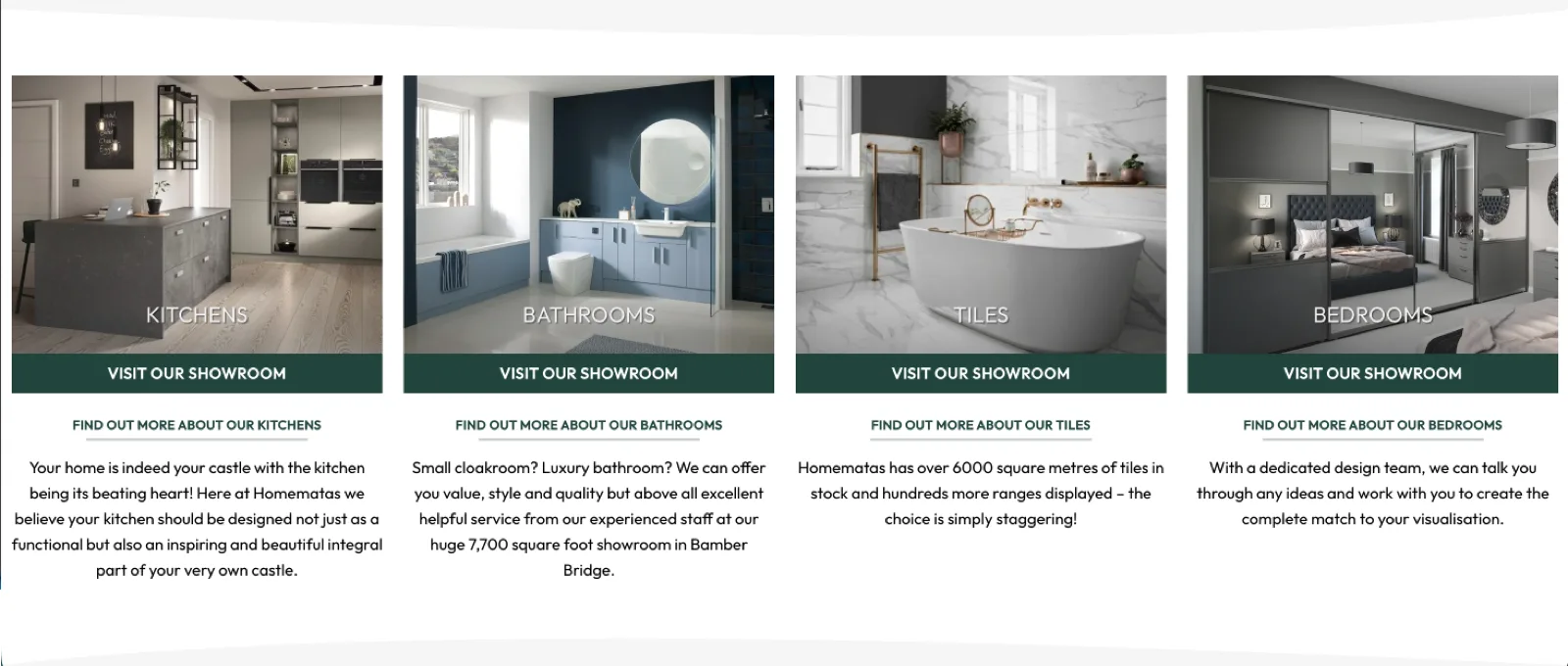
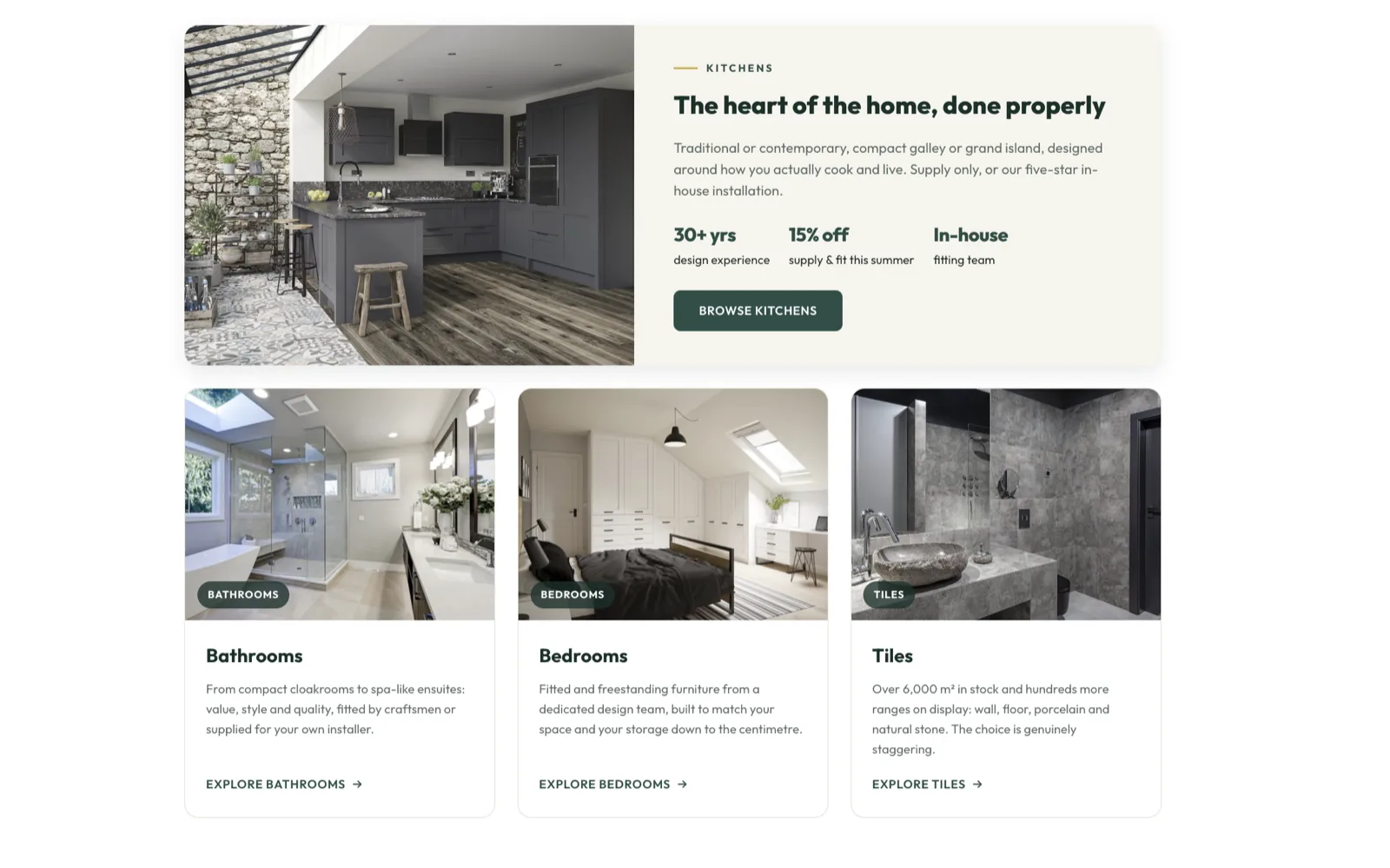
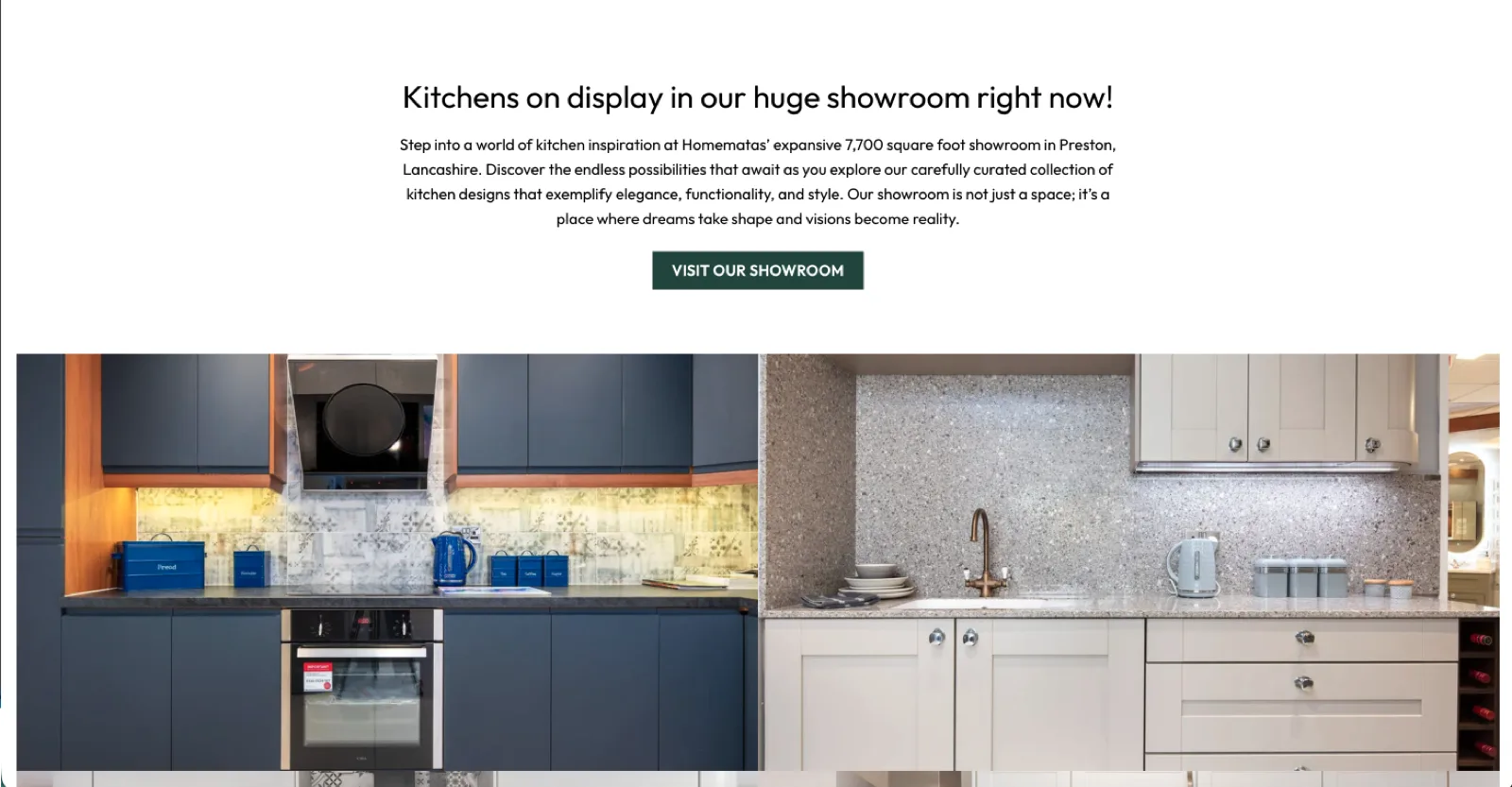
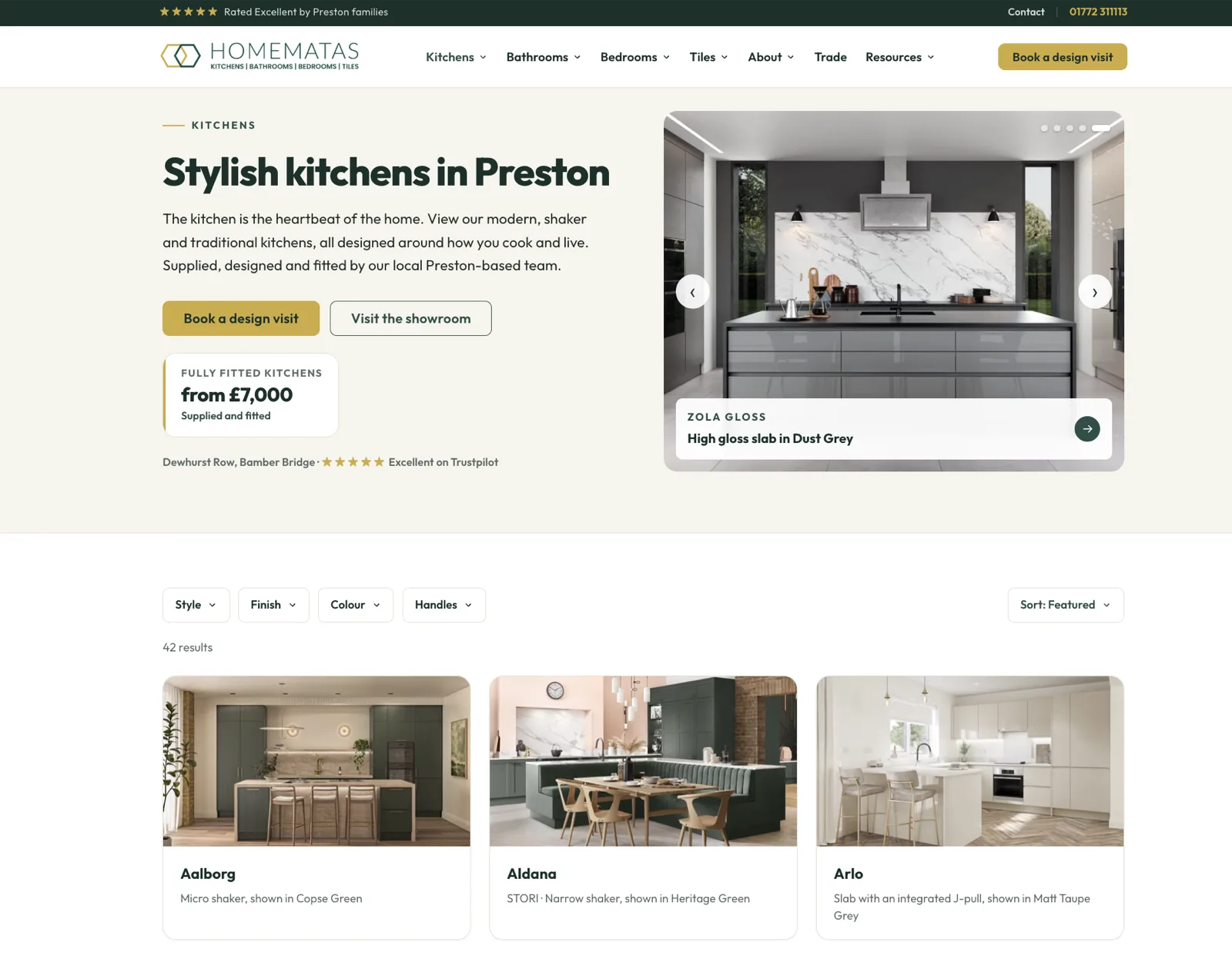
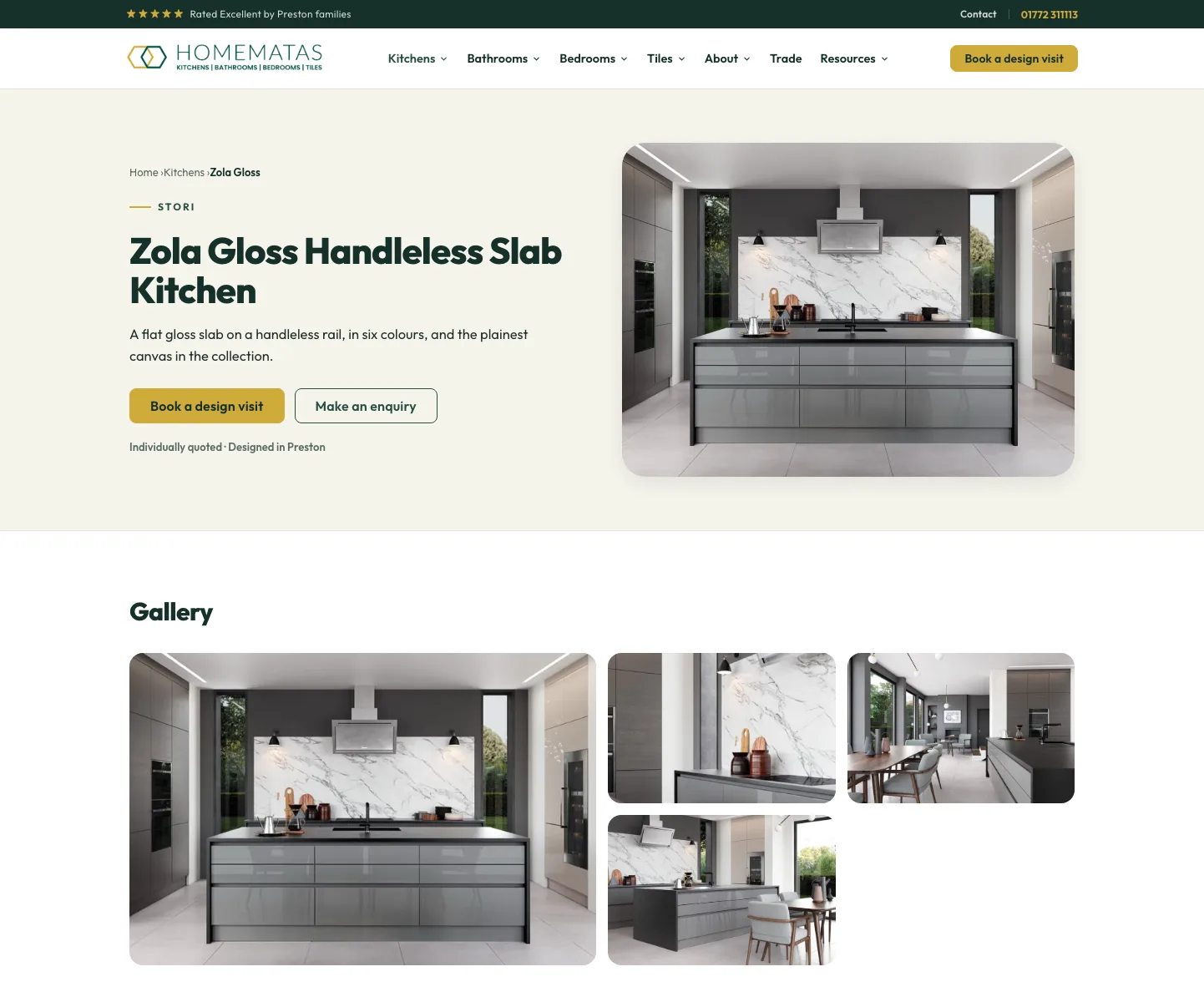
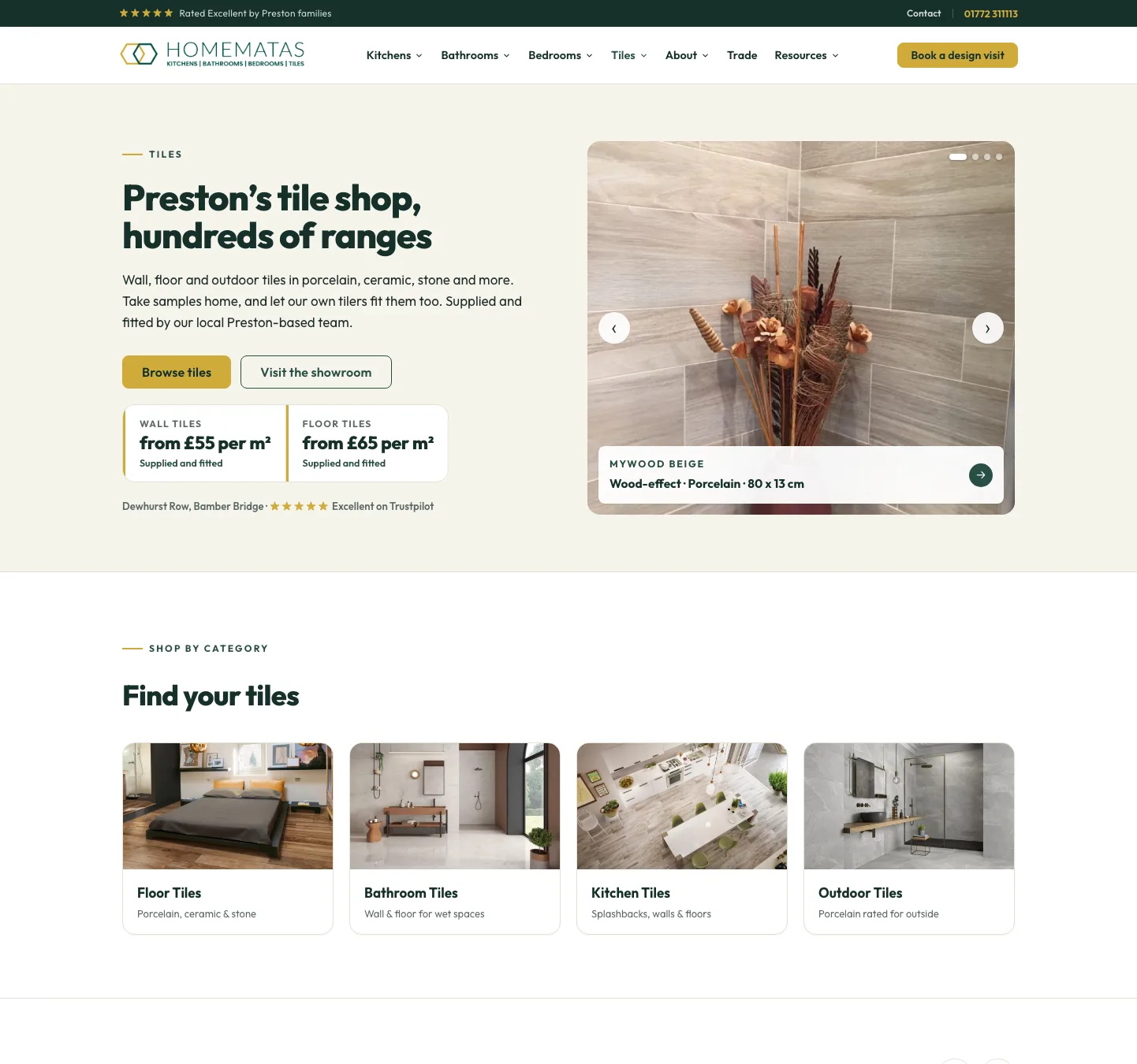
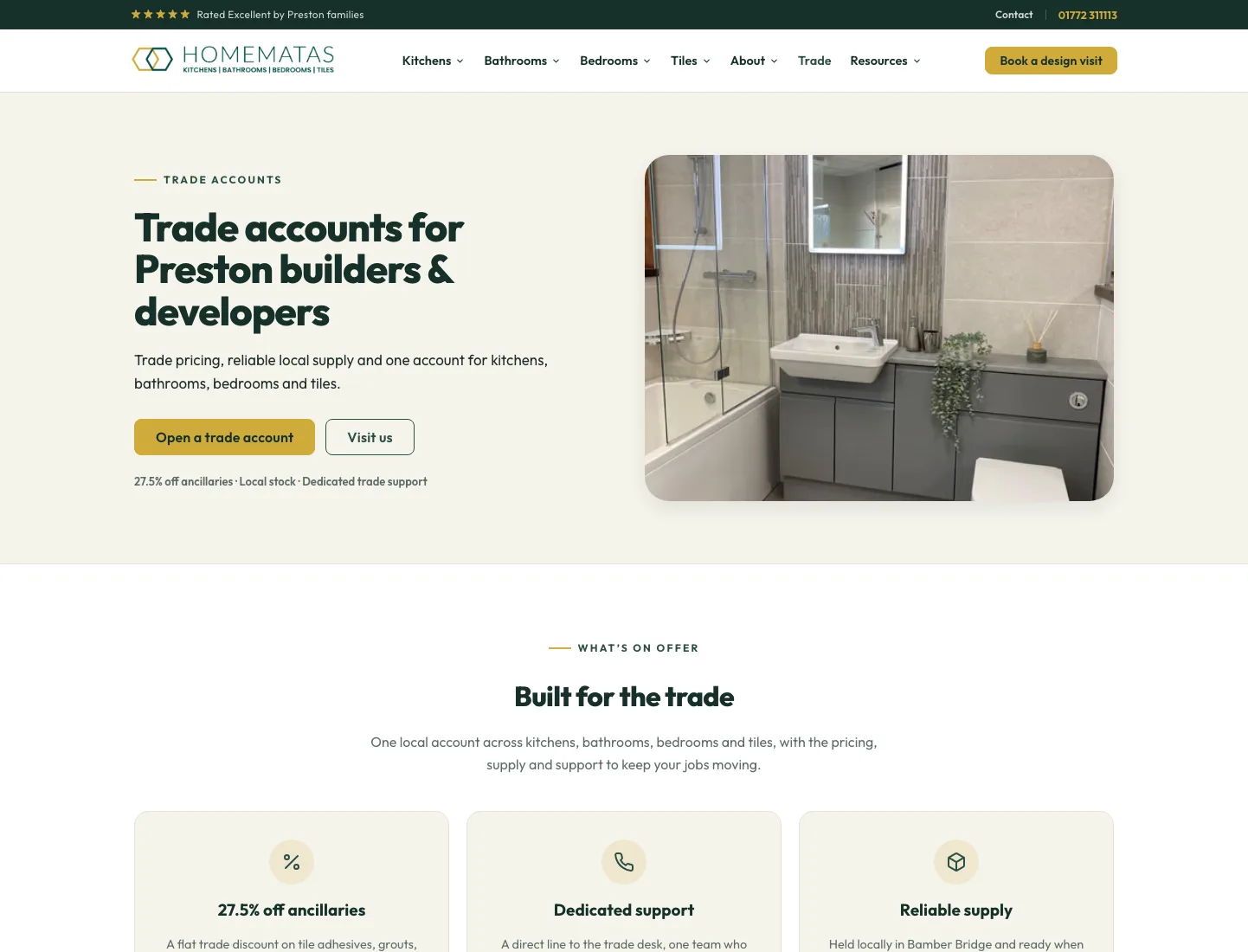
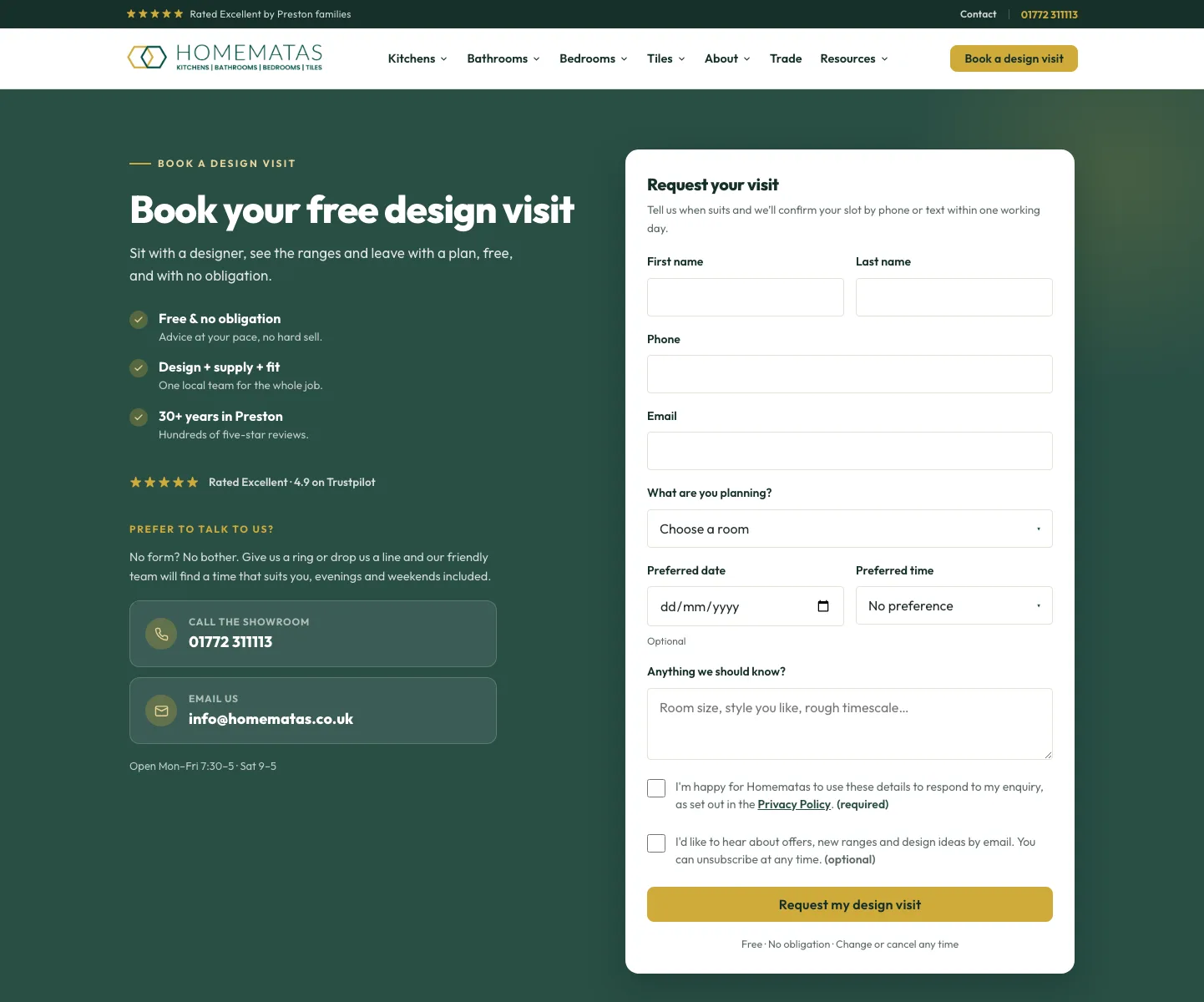
316 ranges, four catalogues, one build.
This is what made it our biggest project so far. Not the design, and not the page count on its own. It was turning four supplier catalogues into four browsable, filterable, individually addressable sets of pages, and doing it without a shop attached.
The filters run client-side on a static build, so the browsing is instant and every range still has a real URL a search engine can index. A shop would have been the easy answer and the wrong one. Homematas sells by appointment, so the catalogue ends in a design visit rather than a basket.
A decade of URLs, carried across.
A decade of WordPress leaves a long tail: 200-odd blog posts, a WooCommerce shop, four case-study sections, brochure pages and a media library that had published itself. Losing that tail is how rebuilds quietly cost a business its rankings. So we mapped it, and then we tested every single URL against the new site.
Method, so you can repeat it: we pulled every URL the Internet Archive had recorded for the old domain, filtered to the ones that were real pages rather than WordPress plumbing, and requested each against the new site. Most rebuilds never run this check, which is exactly why the traffic drops a month after launch and nobody can say what caused it.
The old site said the same thing on all 500 pages.
Technically it had structured data. Practically it had one block of it, generated by a plugin, repeated identically everywhere: the business, its address, its opening hours. Useful once. Useless for telling an assistant which of 42 kitchens is the handleless one. That is the gap answer engine optimisation actually describes, and it is the gap the local leader had been quietly exploiting for years.
“Really pleased with our new website and the service we’ve received. They’ve been professional, efficient, knowledgeable and so easy to work with from start to finish.”
“Communication has been great, nothing has been too much trouble and they really listened to what we wanted. Very competitively priced too. Would definitely recommend, a great service all round.”
There are no traffic or booking numbers on this page, because the site went live this month and anything we printed today would be noise. GA4 and the design-visit and brochure forms went on at launch, so bookings are being counted from day one against a baseline that starts at zero. This rebuild is also only the first half of the job: the SEO and AEO programme starts next, and winning back the visibility lost since January is its first target. We will come back and put the numbers in.